
Project Objetives
ZZNets · Scientific objectives
Project objectives
ZZNets pursues four scientific objectives that together define, model, optimise, and measure a Hypercell-based energy-saving solution for future 3D mobile networks — from the protocol design to components of the AI-driven optimisation of the resulting network
- SO 1Hypercell-based energy-saving solution
- SO 2Sky-to-indoor coverage performance evaluation
- SO 3AI-based network modelling
- SO 4AI-based network optimisation
Hypercell-based energy-saving solution
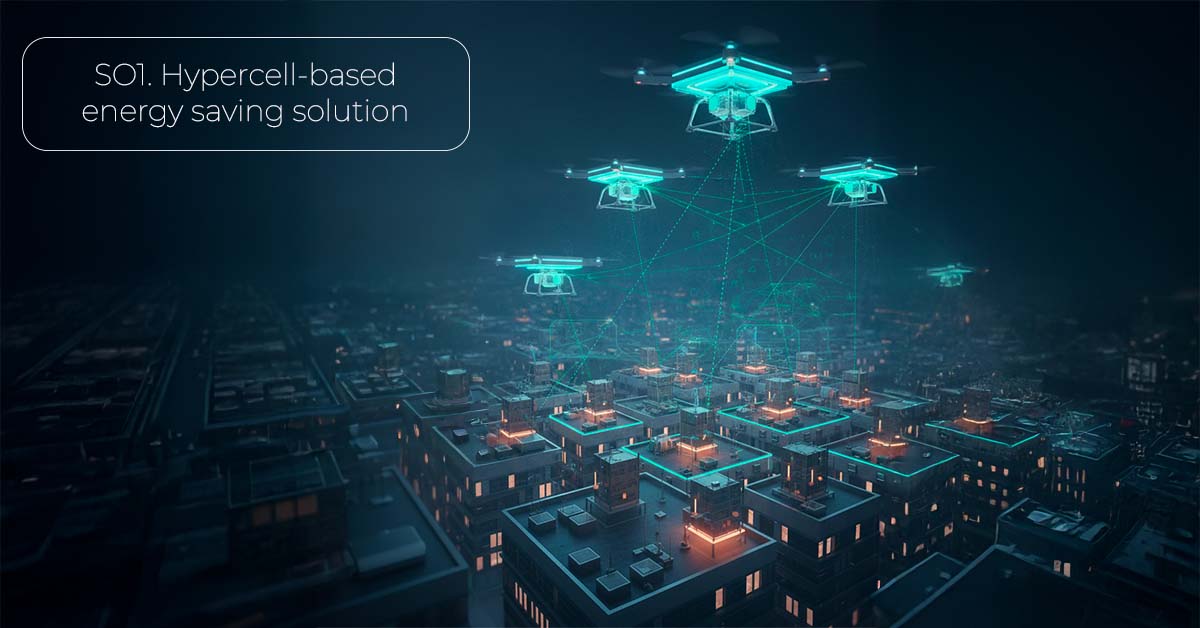
The first scientific objective is to define the protocols and algorithms of a new Hypercell-based energy-saving solution. In our vision, (tethered) drone- or HAPS-assisted Hypercells are classified as basic coverage cells and paired with a set of overlaid terrestrial capacity cells.
Capacity cells monitor their traffic conditions and key performance measures, and can autonomously shut down provided that their traffic load can be safely offloaded to the paired Hypercell. The Hypercell, in turn, monitors its own traffic and performance and oversees turning its paired sleeping capacity cells back on when required.
- Capacity cells can be paired with multiple Hypercells,avoiding border effects and uncontrolled handovers.
- Information exchange between Hypercells and paired capacity cells through AI models,enabling optimal and adaptive shutdown and wake-up decisions.
- Protocol design
- Cell pairing
- Autonomous shutdown
Sky-to-indoor coverage performance evaluation
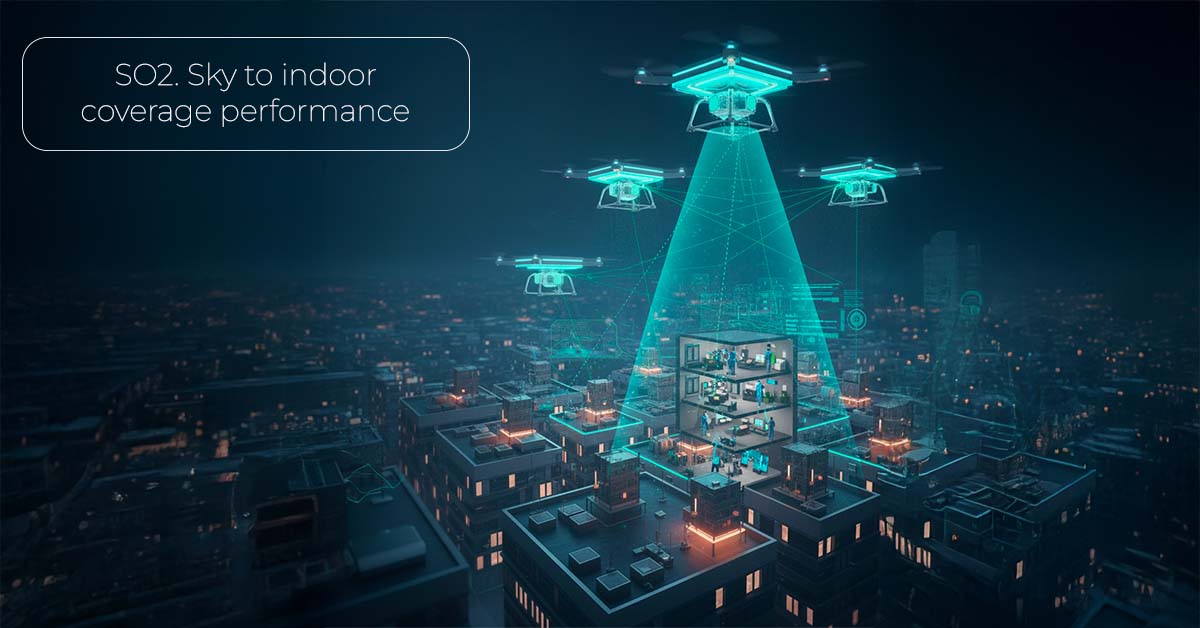
Around 80% of overall network traffic is consumed indoors, and most users stay indoors at night-time — precisely when the largest opportunity for network energy savings exists. The second objective is therefore to quantify the extent to which (tethered) drones and HAPSs carrying a base station can effectively offload indoor traffic in a dense urban scenario, as a function of their flight and networking configurations.
To gain this understanding, we aim to empirically measure — for the first time — the indoor signal strength and coverage quality provided by an outdoor base station flying on a (tethered) drone, within buildings of distinct characteristics and at various indoor locations, while the base station operates at different frequencies, heights, transmit powers and antenna configurations.
- Empirical measurements
- Tethered drones
- Data-driven propagation models
AI-based network modelling
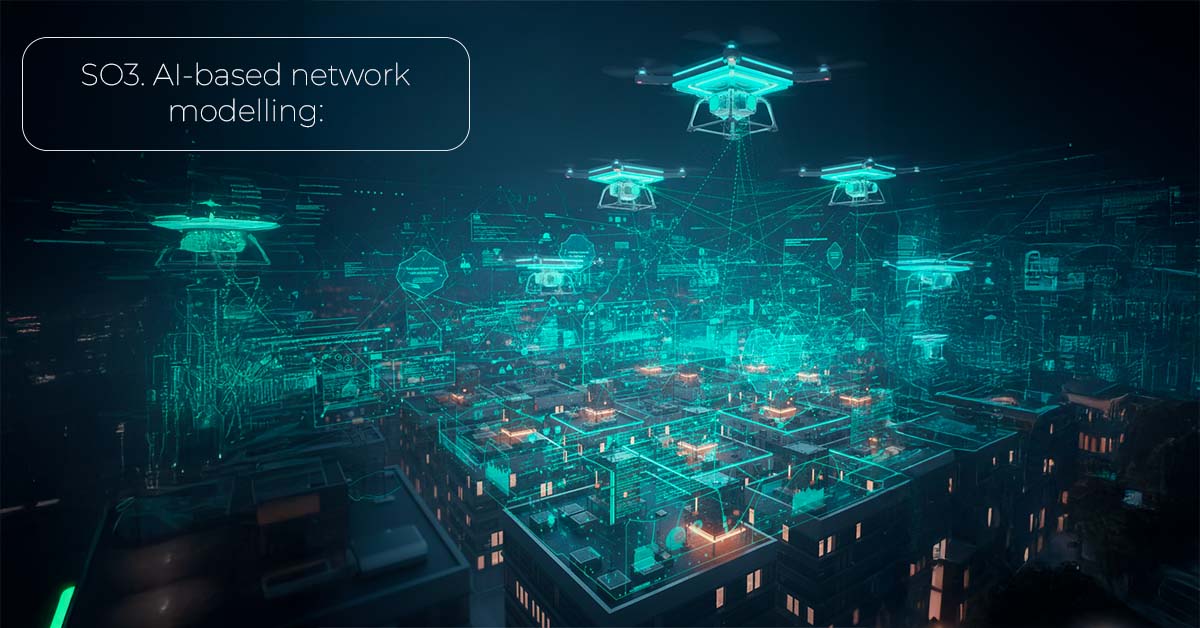
Building upon the outcomes of SO1 and SO2, the third objective is to develop an AI-based model of the proposed 3D network and energy-saving solution, capable of accurately predicting its energy efficiency even under network configurations — especially concerning the flying base station — that were not present in the measured data.
Predicting exact network performance at millisecond level is impossible given the size and stochastic nature of cellular networks. The goal is therefore to optimise the statistical performance of the proposed 3D network.
- Lightweight AI estimators that accurately assess energy consumption, coverage quality and data rates of a base station.
- Digital twin grounded in expert- and AI-based models, generalising inference from base station level to network level.
- Lightweight estimators
- Agent-based modelling
- Statistical prediction
AI-based network optimisation

The fourth objective is to push the boundaries of network optimisation by advancing existing black-box, stochastic optimisation concepts. Optimising the proposed 3D network using the expert- and AI-based model developed in SO3 involves large-scale, stochastic, non-linear, non-stationary and multi-objective problems — potentially with hundreds of optimisation variables and trillions of candidate solutions.
Our ambition is to create tailored off-line and on-line AI-based optimisation frameworks able to identify high-performing carrier-shutdown solutions in terms of network energy efficiency and user experience, while ensuring convergence in reasonable times. Achieving this requires incorporating expert network knowledge into the optimisation problem, and benchmarking the resulting tools against state-of-the-art reinforcement-learning approaches.
- Black-box optimisation
- Multi-objective
- Reinforcement-learning benchmark