
A new 3D network architecture, driven by tethered drones, redefining zero-energy cellular networks.
ZZNets introduces the Hypercell — an aerial or non-terrestrial coverage layer that takes over blanket coverage at night, letting terrestrial cells sleep without losing service.
The vision
Cells that sleep, coverage that stays.
Today's energy-saving mechanisms hit a wall: terrestrial coverage cells must stay awake to guarantee service. ZZNets moves that role to the sky, so the ground layer can shut down when nobody needs it.
-
Zero-bit, zero-energy network vision
Protocols for a Hypercell solution that enables terrestrial cell shutdown and delivers the 6G vision of zero-bit, zero-watt networks.
-
Tethered drone Hypercells
A proof of concept for a low-energy Hypercell: a 5G base station mounted on a tethered drone providing blanket night-time coverage.
-
Sky-to-indoor coverage study
Measuring, for the first time, the indoor coverage provided by a drone-assisted base station — critical, since 80% of traffic is consumed indoors.
-
AI-driven 3D network modelling
Lightweight AI estimators fused with an expert-based network model (ABM theory) to predict energy efficiency for any 3D configuration.
-
Advanced network optimisation
Tailored AI-based optimisation frameworks for large-scale, stochastic problems, maximising energy efficiency and user experience.
Scientific objectives
Four objectives, one architecture
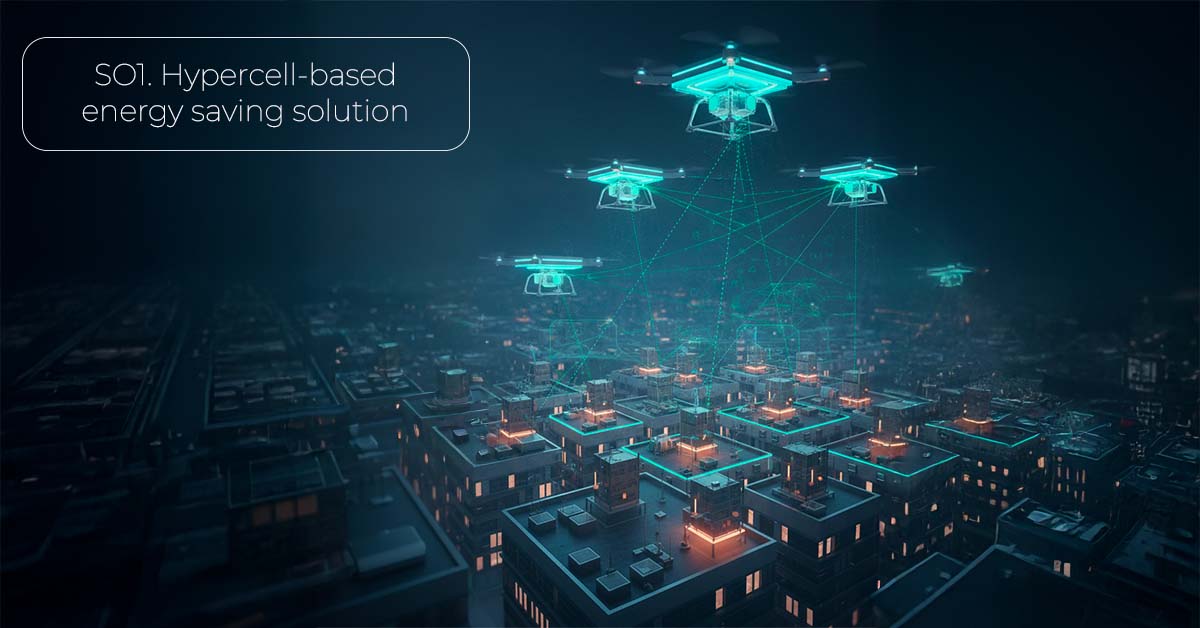
Hypercell energy-saving solution
Protocols and algorithms pairing drone-assisted Hypercells with terrestrial capacity cells.
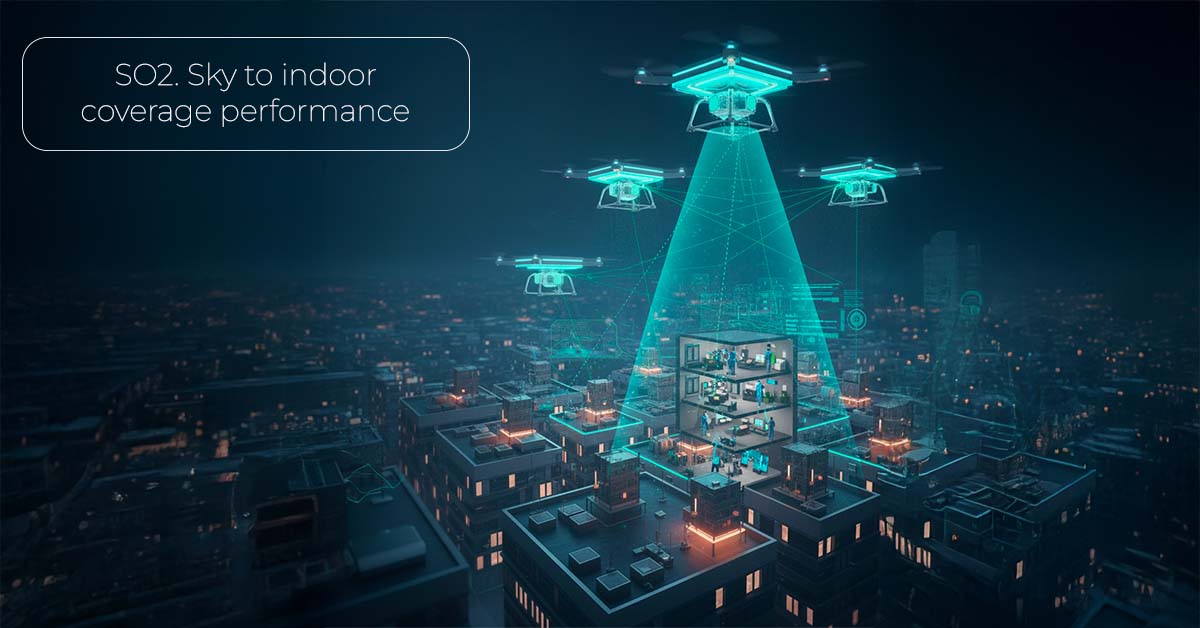
Sky-to-indoor coverage
Quantifying how well a flying base station offloads indoor traffic in dense urban scenarios.
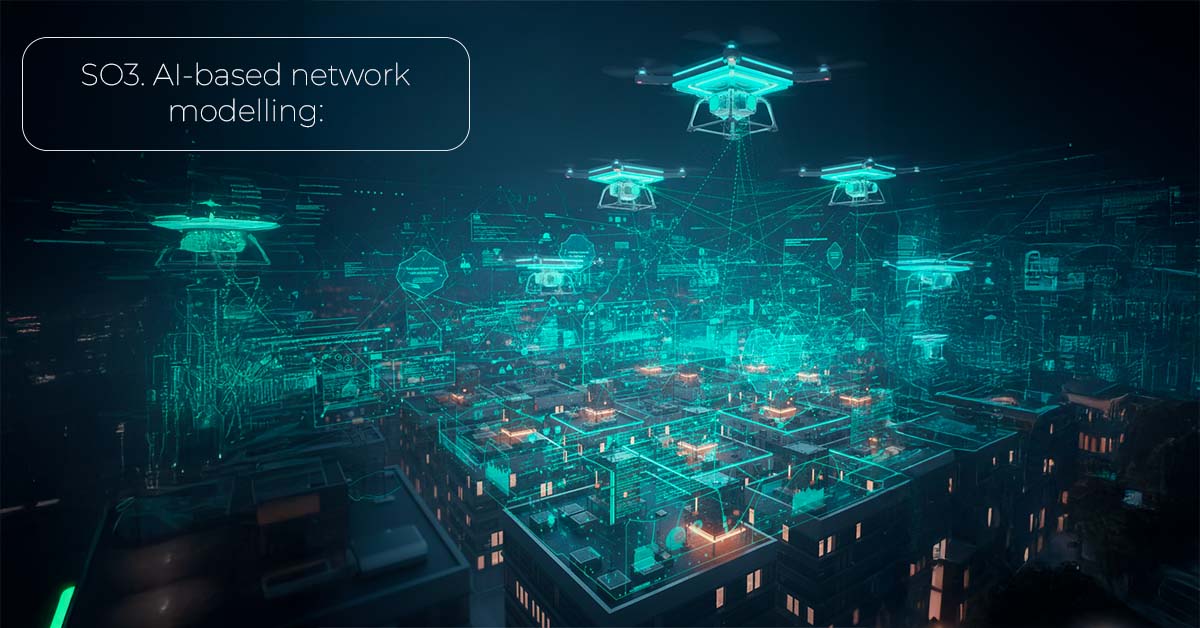
AI-based network modelling
Predicting the statistical energy efficiency of any 3D network configuration.
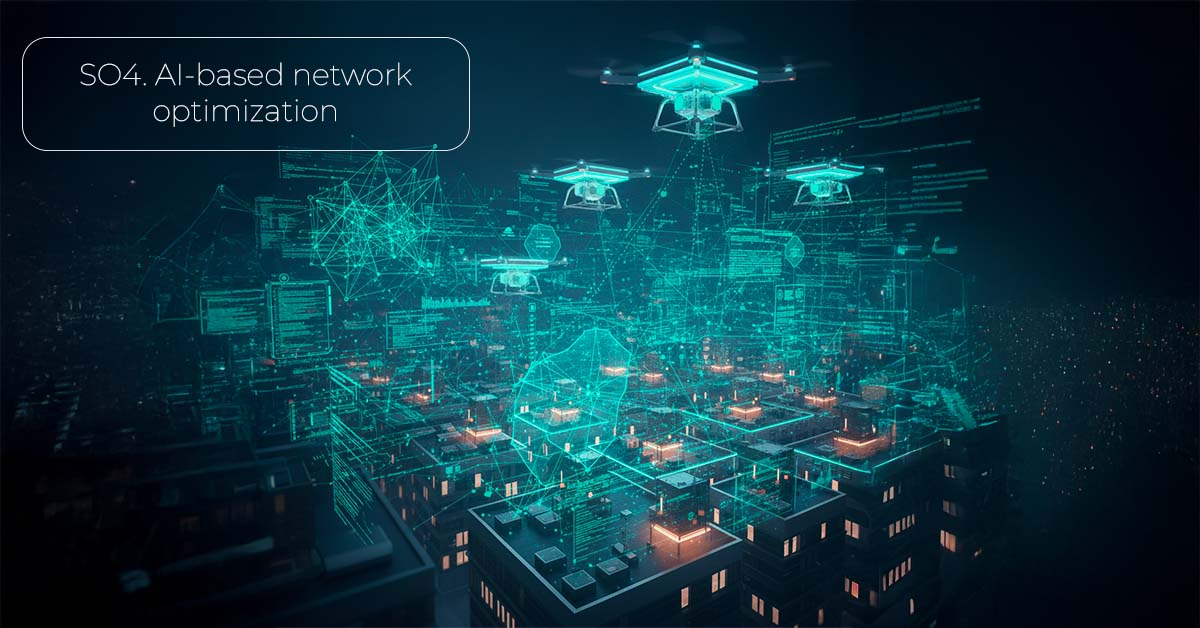
AI-based network optimisation
Off-line and on-line frameworks for large-scale, stochastic, multi-objective problems.
Work programme
Activities
Hypercell architecture and carrier-shutdown protocol
Two candidate architectures, a dynamic cell-pairing algorithm and a distributed shutdown protocol, supported by AI building blocks for traffic-, quality- and energy-aware decisions.
Propagation campaigns and the experimental platform
Outdoor-to-indoor measurements across five frequency bands and three floors, plus the first Hypercell platform built on commercial 5G equipment and a tethered drone.
AI modelling and the network digital twin
Generative channel modelling, traffic forecasting from NWDAF data and SINR prediction, integrated into the GPU-accelerated Giulia system-level simulator.
Optimisation foundations for AI-based Hypercell operation
A theoretical optimisation framework and the BLASTER algorithm, extended with Bayesian optimisation, reinforcement learning and transfer learning alongside UPF and Huawei.
Key results
What the project has proven so far
From a theoretical formulation to a drone flying a commercial 5G cell over the UPV campus.
Outputs
Dissemination
Journal articles
Peer-reviewed papers in IEEE Transactions
Other publications
Conferences, a book chapter and open-access outputs
Conferences and talks
Keynotes, tutorials, invited talks and posters
Doctoral theses
Ongoing at UPV-iTEAM
Internationalisation
Workshop, Huawei project and an MSCA-DN proposal
Knowledge transfer
Impact and transferable results
Partnerships
Built with academia and industry
CITIC-UGR, Universitat Pompeu Fabra and ETSIADI-UPV
Professional propagation measurement campaigns, methodological expertise in Bayesian optimisation and reinforcement learning, and the drone operations behind the Hypercell platform.
Read more Industrial · Huawei TechnologiesFrom research results to industrial validation
Expertise on energy-efficient RAN, carrier shutdown and digital twins — now continuing through a new joint industrial research project on 5.5G/6G simulation.
Read more